Who Sets the Defaults
Written April 2026. Revised 12 November 2026 for this edition.
The seat at the AI table is meaningless if the CMO arrives with the wrong artifact. The intelligence layer will render your brand. The question is whether you have told it what your brand is.
An evening in April 2026. I am walking home from the gym in Amsterdam East, earbuds in, phone in my pocket, asking ChatGPT whether The Coffee Company is still open.
It does not know what I mean.
The Coffee Company is a real chain in this city. Branches, staff, a logo, queues at lunchtime. Every human here knows exactly what you mean when you say the name. ChatGPT hears a category descriptor. It asks me which coffee company. I clarify. It lists firms that sell coffee. I clarify again. Eventually it locates the chain, after I have effectively explained the brand to the AI.
I am walking through Amsterdam having a conversation with a system that cannot see the brand I am asking about.
The brand has done nothing wrong. It named itself decisively enough that every human in this city knows exactly what the words mean. A name that claims a category in the human ear is a name that vanishes in the machine one.
This is a small failure. A consumer looking for coffee, resolved in under a minute. But it is a legibility failure, and legibility is the primitive layer of everything else the agentic economy is about to ask of a brand. If the agent cannot find the name, nothing else — voice, positioning, meaning, lovability — has anywhere to land.
Open any CMO report published this quarter and the same sentence rises out of all of them. Claim a seat at the AI table. Orchestrate the stack. Lead the conversation with the CTO, the CIO, the CFO. The chorus is unanimous.
Which is the first clue it has no edge.
When every report in a market arrives at the same conclusion in the same quarter, two things are true at once. The conclusion is probably correct. And the conclusion is almost certainly not enough.
The chorus is not a trend. It is the sound of a table being rebuilt.
The shift underneath
In the first quarter of 2026, Amy Webb's Future Today Strategy Group retired its nineteen-year annual Tech Trends Report and replaced it with a new format called Convergence Outlook 2026. The retirement was deliberate — an act of creative destruction by the organisation that had been the industry's reference map. Her argument for the change: individual trends are insufficient. What matters now are convergences, by which she means multiple forces colliding at system level in ways that redistribute power and are hard to reverse.
Trends are weather. Convergences are climate.
The convergences Webb names are not forecasts. They are environments inside which business is already being conducted. Agentic economies. The post-search internet. The new labor equation. The transaction that once was an act a person initiated becomes, in her phrase, an outcome a person inherits. The interface shifts from screens to delegation. The monetisable unit shifts from impressions to completed actions. The visible marketplace gives way to machine-speed bargaining layers underneath.
This is why the chorus sounds unanimous. The table has been rebuilt underneath the conversation.
What Block published
Into this convergence, on 31 March 2026, Jack Dorsey's Block and Sequoia Capital published From Hierarchy to Intelligence. It is not a strategy paper. It is a restructured company. Block had cut forty percent of its workforce in the preceding weeks — roughly four thousand people — and the essay is the intellectual argument for what the remaining company is becoming.
The essay opens on the Romans. The contubernium — eight soldiers under a decanus — as the original unit of span-of-control, and the seed of every organisational hierarchy since. Dorsey and Botha use the reference the way American business essays typically use Rome: as scaffolding, load-bearing but borrowed. For me it woke up a different kind of attention. I am Italian. Any essay that opens with the contubernium has my attention before the argument begins. Dorsey is not borrowing a metaphor. He is naming the starting point of a line I happened to enter two thousand years downstream.
The architecture they propose to replace it with has four parts. Atomic financial capabilities, built as primitives without interfaces of their own. Two world models — one describing the company to itself, one describing every customer to the system. An intelligence layer that composes capabilities into customer-facing moments in real time. And a set of product surfaces — Square, Cash App, Afterpay — as delivery channels for whatever the intelligence layer decides to render.
The pyramid becomes a circle. Intelligence moves to the centre. Humans move to the edge. No permanent middle management, because the world model handles alignment and the intelligence layer handles composition.
What Dorsey and Botha have built is the clearest corporate expression of Webb's agentic convergence. The organisation itself becomes an intelligence. Customer moments are no longer designed by product managers. They are rendered by the system, for the individual, at the instant the model recognises the situation.
Scan the architecture. Capabilities. World model. Intelligence. Interfaces.
Where is brand?
The missing hemisphere
It is not there. Not as a codified input. Not as a governed layer. Not as a source of truth the intelligence layer refers to when composing a customer moment. The manifesto is the most intellectually coherent vision of the AI-native organisation yet published. It names every structural element required to run a company as an intelligence. It forgets to name the one that makes the company recognisable.
Webb says this at landscape scale in a single sentence.
Power doesn't disappear in the agentic economy. It migrates — upstream, invisibly, to whoever sets the defaults.
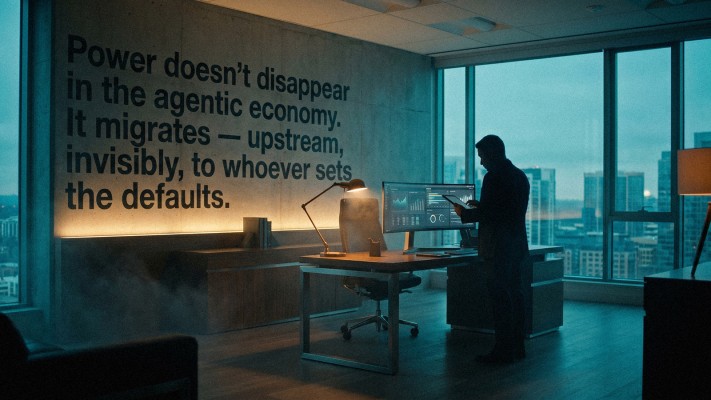
That sentence should be printed on the wall behind every CMO desk. Inside an intelligence layer, the defaults are set by the world model. Whatever the world model knows, the intelligence layer renders. Whatever is not in the world model is not there to render. A brand that has not been codified into the model does not migrate upstream. It does not migrate anywhere. It gets flattened into functional fit, optimised for completion, reduced to whatever the system can measure.
Webb names the endpoint elsewhere in the same report. She calls it the Reputation Ledger: the moment when an agent, acting for a consumer, measures product performance through sensors and logs and cross-referenced data, and treats that measurement as the final word on the brand. In her phrase, brand reputation reduced to computational output.
This is the Coffee Company problem escalated. At the small scale, the agent cannot see the brand by name. At the larger scale, the agent can see the brand but composes everything about it — voice, value, recommendation, refusal — from scraped signal and measured performance, with no governed input from the brand itself. Legibility without lovability, at scale.
The intelligence layer will render your brand. The question is whether you have told it what your brand is.
Three layers of legibility
Every brand now sits somewhere on a three-layer stack.
Layer one — Name. Can the agent find you? Can it distinguish your brand from the category you operate in? This is where The Coffee Company fails. A name that reads as descriptor to the model is a name that is not there until a human teaches the model what it means. Owning a category in the human ear is no longer the same thing as owning it in the machine ear.
Layer two — Signal. Once the agent finds you, what can it read about you? Most brands live here. The agent has scraped their site, ingested their reviews, harvested whatever structured data it can reach. It can describe the brand — in its own words, from signals the brand did not author. The brand is visible but not governed.
Layer three — Defaults. When the agent composes a recommendation, a description, a refusal, an action — whose inputs does it draw on? If the answer is the brand's codified source of truth, the brand is setting the defaults. If the answer is whatever the model could infer, the system is setting them.

Most CMOs are operating at Layer 2 and assuming that is the whole problem. It is not. Layer 3 is where every serious strategic question will now be answered, and almost nobody is there yet.
The seat, reconsidered
This is what makes the chorus insufficient without being wrong.
Webb is explicit about the stakes. In her analysis of the new labor equation, she writes that when workflows become standardised and AI-mediated, competitive advantage may shift away from execution toward trust, relationships, brand strength, and proprietary data. Culture and human judgment, she argues, may become more strategic, not less. This is the CMO's mandate written by an outside authority. It does not need translation.
But trust, relationships, and brand strength do not survive by being asserted in a meeting. They do not survive by being referenced in a deck. They survive by being codified — machine-readable, governed, and available to the intelligence layer as a source of truth the system refers to when it composes a moment for a customer.
The seat at the table is meaningless if the CMO arrives with the wrong artifact. A persona deck, a brand platform, a tonal refresh, a campaign plan — these carry no governance weight inside an intelligence layer. The intelligence layer cannot read them. They were never built to be read by a machine.
The artifact is a Brand Constitution. A codified source of truth that defines what the brand is, what it refuses, how it sounds, what it values, and how those commitments are expressed as structured inputs to the systems that will increasingly render them. Machine-legible to the intelligence layer. Human-lovable to the people the intelligence layer serves. Both at once, by design, not by hope.
This is an operating-model shift, not a rebrand. It changes what brand is accountable for inside the company — no longer the coherence of campaigns, but the governance of the inputs that feed every rendering system the organisation operates. It is the artifact that makes a CMO institutionally usable in an AI strategy conversation, rather than visionary and adjacent. It is defensible to the board, because it names a bounded deliverable with a governance function the CFO can read and the CTO can integrate.
Seat at the table becomes Constitution on the table.
Everything else is decoration.
What the evidence says
Block is the extreme point on this curve. Most companies will not restructure as aggressively. Deloitte's State of AI in the Enterprise 2026 reports that eighty-four percent of organisations have not yet redesigned jobs around AI. The modal enterprise is still in the first phase — training staff, onboarding tools, optimising existing workflows with new software. Most CMOs are not walking into Block's architecture. They are walking into its absence.
That absence is the misleading part. The MIT and Oak Ridge analysis Webb cites estimates that AI is already technically capable of replacing tasks equivalent to 11.7 percent of the US labour market — roughly 1.2 trillion dollars in annual wages. The number matters less than its shape. A shift of that scale does not arrive as layoffs. It arrives as slow hiring, quiet attrition, expanding output without expanding payroll. Headcount drifts downward. Revenue rises. The architecture changes under the organisation while no one is looking.
Block is not a prediction. Block is the first company to admit in public what the spreadsheets of the modal enterprise have been quietly proving for eighteen months. The convergence is the condition Block is merely responding to fastest.
If the CMO's window is structural, it is the near horizon. Not the long one.
What this looks like on Monday morning
The practical move has three steps.
Start with an audit. Open the agents your customers now use — whichever are relevant to your category — and ask them the questions your customers are asking. Note where the agent cannot find you by name. Note where it finds you but describes you in terms you did not choose. Note where the descriptions drift from what your brand is. This diagnoses which of the three legibility layers your organisation is stranded at.
Identify what is uncodified. Values, distinctions, refusals, voice moves, the sentences you would never let a campaign publish. These exist somewhere in the organisation — usually in the heads of a few senior people, sometimes in a platform document, rarely in a form a machine can read.
Commission the first phase of codification — a structured, machine-readable source of truth that sits upstream of the rendering systems, internal and external, increasingly deciding what the brand sounds like when you are not in the room. Internal team, external partner, or a hybrid: the choice turns on whether the people who can write it down already work for you. This is a different artifact from a rebrand or a tone-of-voice refresh. It is the input layer for every agent, tool, and internal system the organisation already operates.
Ninety days. Bounded. Defensible. Produces an artifact that can sit on a table the CTO and the CIO will take seriously.
The part that is unfinished
I am writing this in live territory. The discipline has a name — agentic branding — and the work of defining it is being done in the open, by practitioners, in quarters not years. How exactly a Brand Constitution interfaces with large language models, agent protocols, and retrieval systems is being worked out in real time, and anyone pretending they have a finished playbook is selling something.
One question I am still working through, and would welcome others' thinking on: which function inside the company should own the codification work on day one. Brand is the natural author of the content. But the artifact lives downstream in the architecture, where engineering and data governance have legitimate claims to the seat. The cleanest answer I have today is brand-led, jointly governed. I am not sure that survives contact with most org charts.
The direction is clear. The instrumentation is still being built. What is unambiguous is that the instrumentation will not be built retroactively for brands that did not codify when they had time.
What dies, what lives
Webb closes her report with a question worth reading twice.
What are we willing to let die on purpose so that something more valuable can live?
The CMO's answer, if the seat is to mean anything, has to be specific. Let the hundred-slide brand platform that lives on a shared drive die. Let the quarterly tonal refresh die. Let the performance-marketing logic that consumed thirty years of brand budget die. Let the belief die that any of that, on its own, ever amounted to governance. Codify what endures. Codify what is worth defending when the intelligence layer is composing a moment without you in the room.
Because the intelligence layer is being built either way. And inside it, power migrates upstream, invisibly, to whoever sets the defaults.
Brand is a default — or it is not there at all.
Questions this essay raises
Who sets the defaults when an AI agent acts for a brand?
Whoever supplies the inputs the agent draws on when it composes a recommendation, a description, a refusal or an action. Where a brand gives its agents no constraints of its own, the model's supplier sets them, and the brand is governed at runtime by a document it did not write. That is governance by default, delegated upward. A brand sets its own defaults by codifying how it should act, and even then it does not govern alone: the supplier's rules and the person's own settings each prevail on their own question. The Brand Constitution draws that boundary.
What should a CMO bring to the AI table?
A governed artifact. A persona deck, a brand platform or a campaign plan carries no weight inside a system that composes customer moments, because the system cannot read it. What it can work with is a codified brand: what the brand knows, held in the Brand Brain, and how it should act, set by the Brand Constitution. That gives the CMO a bounded deliverable, one the CFO can read and the CTO can integrate, and it is what the brand's agents act on when no one from the brand is in the room.
What is a Brand Constitution?
The governing logic of the agentic brand: the codified rules, principles, and decision boundaries that determine how the brand should act. It sits above the Brand Brain, which holds what the brand knows. This essay, written in April 2026, calls the Constitution a source of truth; since May 2026 that role belongs to the Brand Brain, and the Constitution governs what the Brain holds. The full definition and its record are on the Brand Constitution page.
Where this sits
Agentic Branding is the discipline of making brands intelligible, governable, and desirable in an AI-mediated world.