The Agentic Brand Operating System
Brand guidelines were written for human readers; AI agents now render brands in real time and need a system, not advice. The Agentic Brand Operating System is that system: a Brand Constitution as the law, a Brand Brain as the memory and case law, and a Brand API as the contract agents read, run as a governed loop with people at the edge who govern, curate, and architect.
The Agentic Brand Operating System
Why guidelines can no longer govern the brand, and what becomes of the people who do
A customer asks their assistant to sort out something ordinary. Replace a worn-out pair of running shoes before a first marathon. In the half-second that follows, the assistant renders an answer, and somewhere inside it your brand is either there, in context, as one of the few worth the person's time, or it is not there at all. You did not stage that moment. You will never see it. It is now where your brand mostly lives.
Somewhere in your company there is a document meant to govern the brand. A brand book, a guidelines deck, a few hundred pages that took a year and an agency to produce. For three decades a document like that was the brand's law. It still governs every human who opens it.
It governs nothing the machine listens to.
A guideline is a set of instructions for a person. It assumes someone on the other side who can read "confident, but never arrogant" and know what to do with it in a situation the rule never anticipated. That held for thirty years because the interpreter was always human. An agent is not. It has exactly as much nuance as you encoded, and not one degree more. It does not read between the lines; there are no lines to read between, only what is legible and what is missing. An agent can ingest the whole document in a breath; reading was never the problem. What it reads there is advice, and advice does not permit, refuse, constrain, or escalate. So the brand book does not fail because it is badly written. It fails because the reader it was written for has left the room.
It is worth being precise about that word, rendered. The agent does not retrieve your brand and pass it on intact. It generates a version of it, live, in the moment of need: the words, the explanations, the images of the product, even the interface conjured on the spot for the person to act through. And it decides which version appears at all: what is surfaced or skipped, ranked, summarised, voiced. So rendering is not only about visuals, and not only about discovery. It is both, and larger than either: your brand produced and placed, in real time, by a system standing between you and the person. Brand is decided at the point of reception, not at the point of creation, and the system now stands at reception.
Picture it concretely. You have a photo of yourself, and you ask your agent to help you dress for a keynote. It puts you on the stage in a suit you already own, and onto that image it renders a pair of shoes and a top you could buy. Those are a brand's products, generated into your own picture, in the room, in real time. The brand was not presented to you. It was rendered into your world.
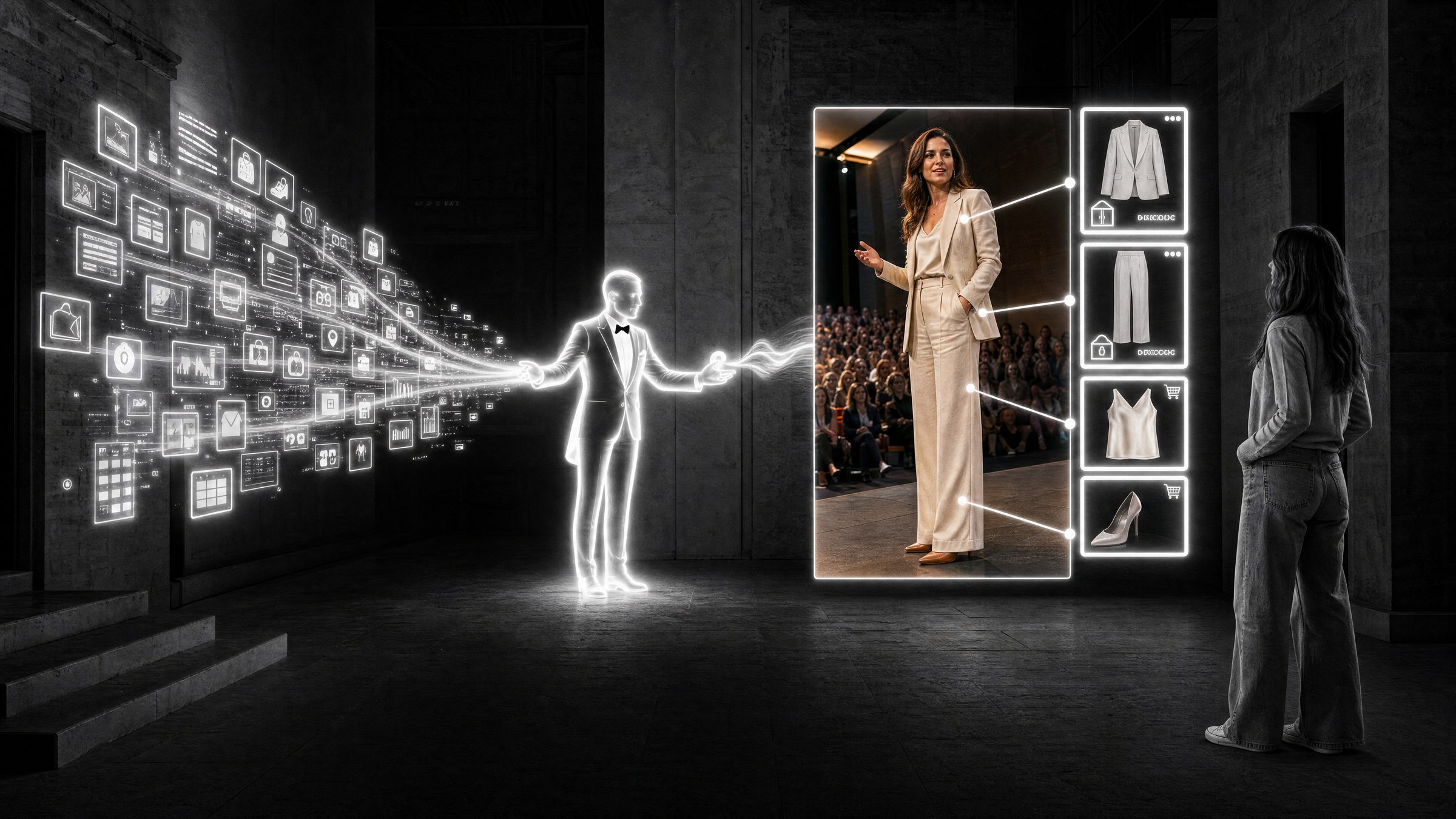
The rendered brand. An agent renders a brand's products into the customer's own world: in context, in real time, on a surface the brand never staged.
Already the ordinary motion of the market
Assistants answer instead of returning links. Purchases close inside a conversation. Service is handled by an agent before a person is reached. Underneath, the connective tissue is being standardised: agent-to-agent protocols, product and policy data machines can read. Then, in the space of three weeks, the agent moved into the operating system itself. At I/O in May, Google introduced Gemini Spark, a personal agent designed to work around the clock in the background, acting across a person's connected tools under their direction.¹ At WWDC in June, the day before I finished this essay, Apple made the same move from the device side: through App Intents, an app's content becomes discoverable, its capabilities become available in natural language, and attribution routes back to the app.² The price of admission is spelled out. To be surfaced at all, what you offer must be legible, actionable, and attributable to the system in between. And at Build, between the two, Microsoft framed the platform shift itself as the move from apps to agents: from software you open to intelligence you invoke, working across apps, workflows, and devices.³ When I wrote a manifesto on this in late 2025, I described the agent that would make this ordinary: a Jarvis of your own, bound to no single device, whispering through your headphones, projected onto the dashboard of your car, present wherever you are, while technology recedes until the agent becomes the interface.⁴ I called what it does to brands the shift from being visited to being rendered. That was a forecast. It has entered the operating system in your pocket.
What the brand runs on
You do not need a better brand book. You need an operating system. Its heart has three layers.
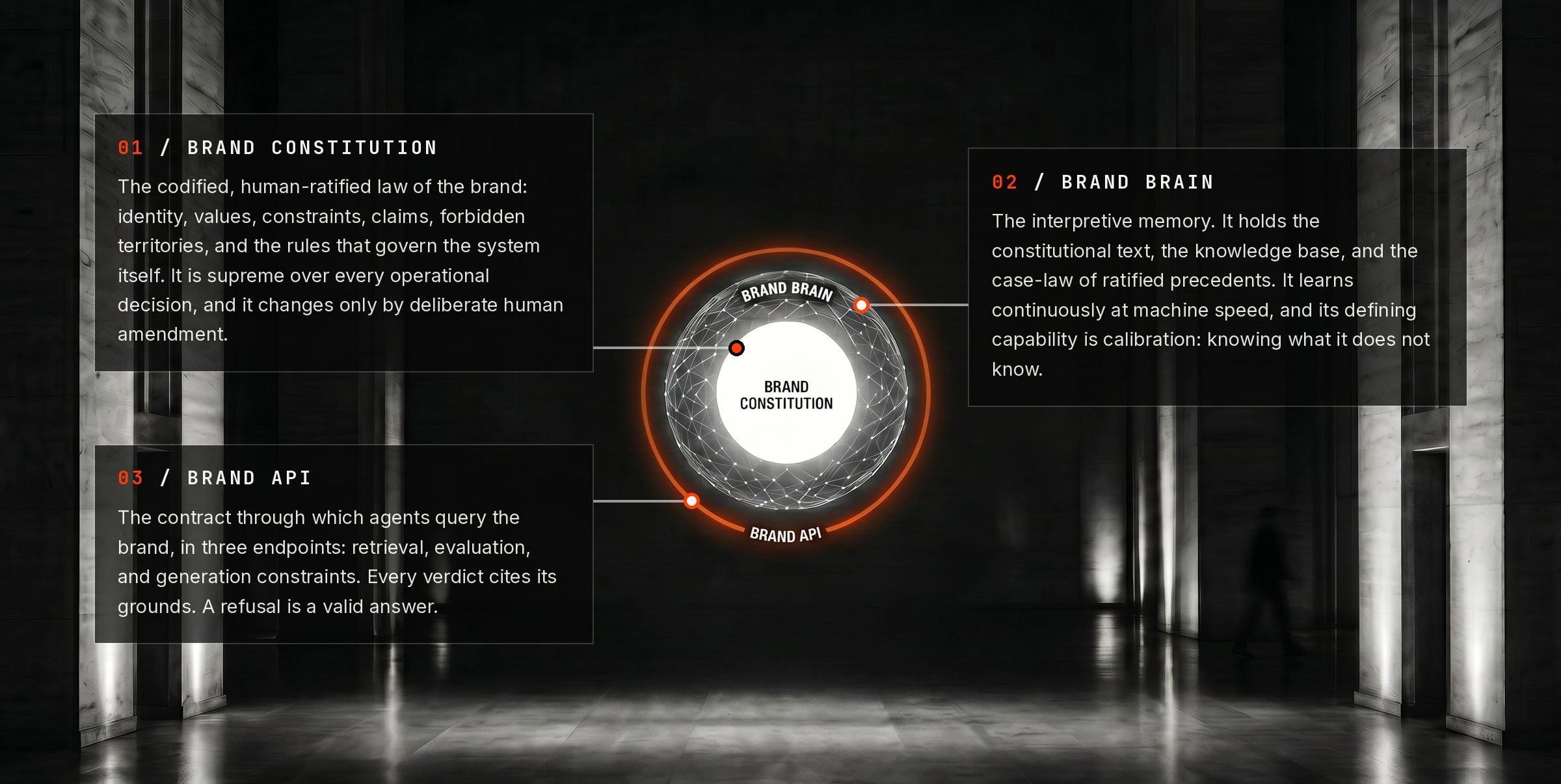
The heart of the operating system. Constitution at the core: the law. Brain around it: the memory and the case law. API at the edge: the contract agents reach into. Authority descends.
The first is the Brand Constitution: the governing layer. Not guidelines with a grander name, but the source of authority: what the brand protects, what it will never do, who holds the decision rights, which trade-offs are settled, how the brand is allowed to change. Where a guideline describes how the brand looks, a constitution states what must hold true in every rendering, so that meaning stays stable even when the brand is generated live by something you do not control. A guideline is read. A constitution is enforced.
Hand an agent a constitution and nothing else, though, and it holds principles with no case history to apply them to. So underneath the Constitution sits the Brand Brain, the memory layer: sources preserved, knowledge synthesised, contradictions tracked, truth kept current and routed back through governance when it changes. The Constitution says what the brand protects; the Brain holds what it knows. And what it knows cannot stop at the brand's own account of itself: agents weigh a claim against reviews, service records, the lived evidence of whether the promise was kept. The Brain holds the proof as well as the story.
It also holds the case law. The Brain's defining capability is not judgement but calibration, knowing what it does not know: settled questions run at machine speed, while a genuinely new one is flagged and escalated. Once a person has ruled, the ruling joins the precedents and the next occurrence runs without asking.
And none of it reaches that half-second unless the machine can get at it. The outermost layer, the Brand API, is the contract: the endpoints an agent reaches into and trusts. Not one endpoint but three. An agent can retrieve what the brand holds, ask whether a thing it plans is on-brand, or request the boundaries before it creates. It exposes the governed brand to everything that now needs to read it. And every verdict returns with its grounds, the rule and the precedent it stands on. When the system is not sure, it does not guess; a refusal that routes to a human is a valid answer. A system that knows when not to answer is the difference between governance and gambling.
Nothing obliges an agent to use any of it.
Nothing obliges an agent to use any of it. An agent in that half-second reads whatever it can reach: the open web, the reviews, a retailer's feed, whatever the platform hands it. The Brand API cannot command an agent's attention; it can only deserve it. It earns its place among the agent's sources the way any source earns it, by being more current, more structured, more attributable, and easier to verify than the noise around the brand.
That is the heart of the system, and it is where most thinking about brand and AI stops: a better-organised pile of knowledge. But the heart is not the system. The system is what runs on it. And the word system is doing precise work: decision rights, versioned rules, evaluation, escalation paths, endpoints. An operating model and a technical layer at once.
One decision, end to end
Take the runner asking for shoes before a first marathon. The agent has to choose what to surface and how to say it, and the operating system shapes every part of that. The Constitution sets the boundaries: what the brand may claim about performance, what it must never promise, the line it holds on price and comparison. The Brain supplies what is true and current: the right product, the fit data, the evidence behind the claims, the stock, the provenance. The API exposes that governed knowledge in a form the agent can act on in the half-second it has. The agent renders the brand into the runner's context: the right model, framed around a first marathon, in language that fits the person. And when the outcome returns, the purchase, the return, the second run, the loop learns, and what it learns routes back through governance.
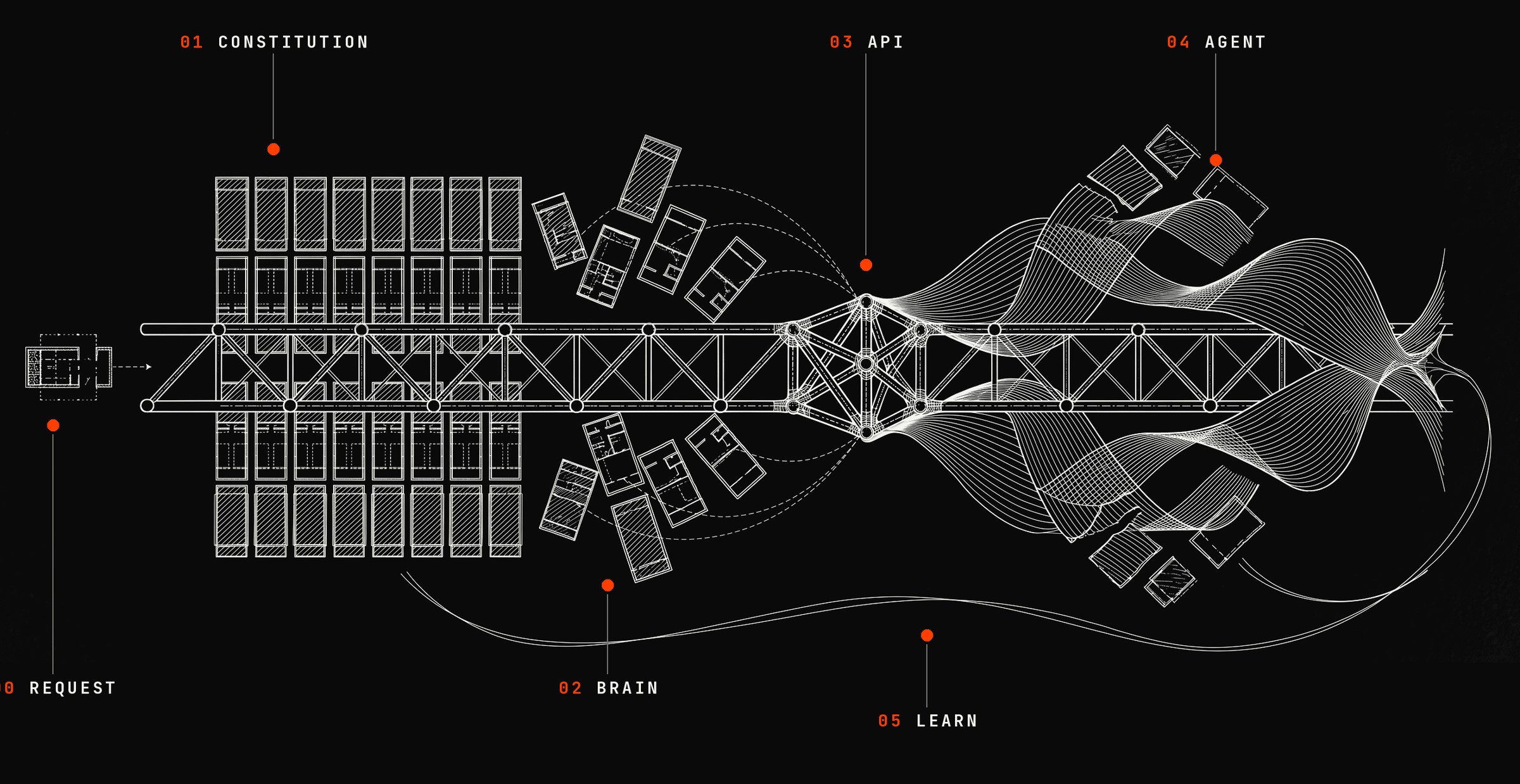
One decision, traced: the runner, the half-second. Request to learn, left to right: the law already set, memory supplying the true, the contract exposing it in the half-second, the agent rendering, the outcome routing back through governance.
And the brand's people? They stand at the points that decide it: setting the claim the brand will stand behind, judging whether the rendered answer actually sounds like the brand, deciding the moment a promise or a discount needs a human yes. The system runs the decision. People hold the ones that matter.
The loop is the system
That cycle has a shape. The operating system senses, taking in signals from customers, culture, channels, the market. It interprets and decides, weighing options against the business, the Constitution, the thresholds it may act within. It orchestrates and acts, triggering the agents, workflows, and content systems that execute. And it learns, feeding outcomes back into the knowledge and the policies. What it learns feeds the knowledge continuously; the Constitution it learns under changes only by human hands. The fast layer learns; the slow layer governs. Sense; interpret and decide; orchestrate and act; learn. A governed cycle that turns brand intent into action, continuously, at a scale no team could reach by hand.
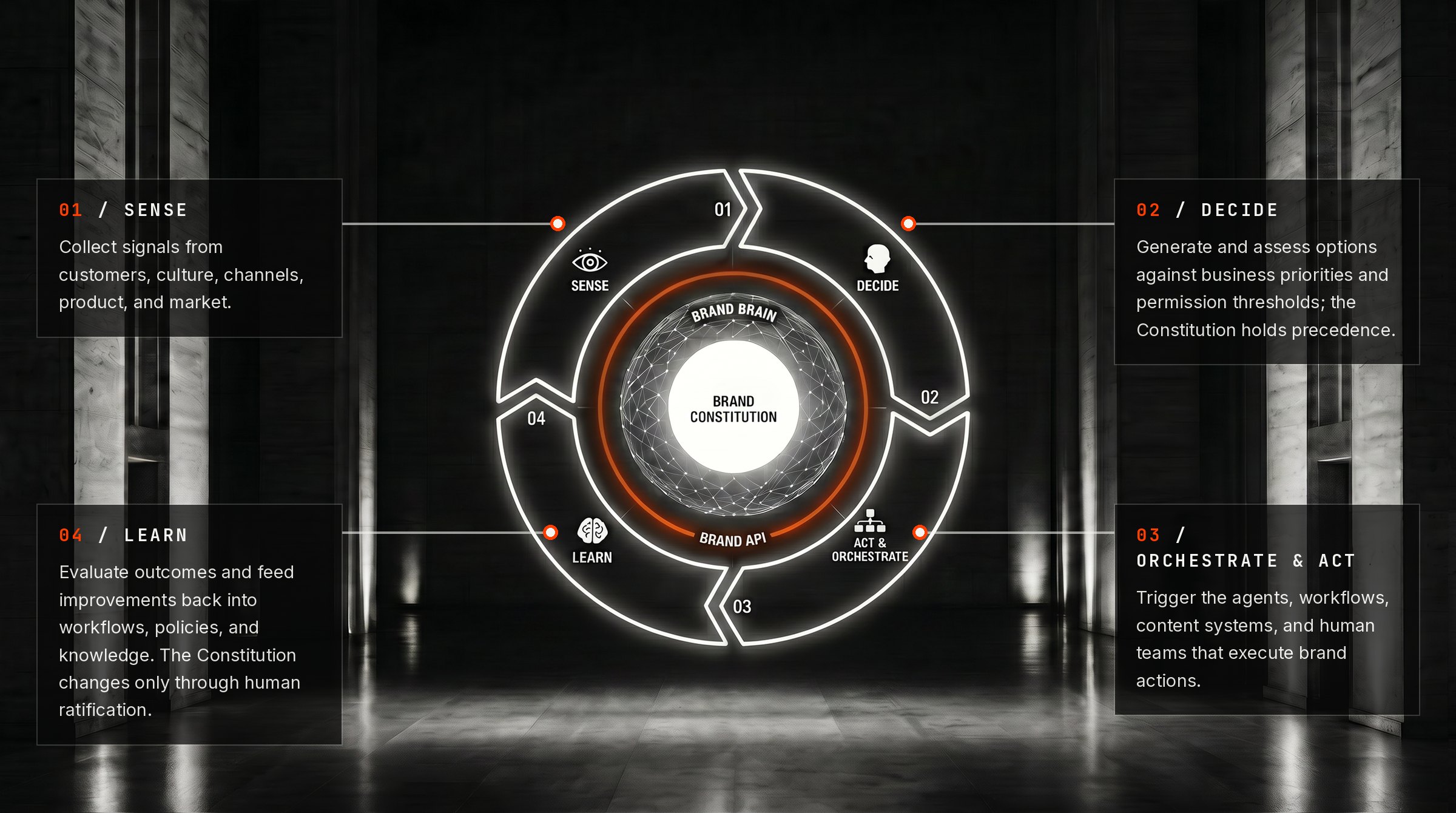
The loop around the heart. Sense, decide, orchestrate and act, learn: the operating cycle running as agent-orchestrated workflows around the governed core. The fast layer learns; the slow layer governs.
The part our industry has not yet absorbed is that the loop is not a human process with AI bolted on. The loop is the agentic system: agents running with skills, tools, and workflows, orchestrating themselves. This is what an AI-native organisation is, not a company that uses AI but one whose workflows are run by agents, with people no longer inside the line of work. Salim Ismail named the shape a decade ago, before the technology could deliver it. He called it the Exponential Organisation, whose output decouples from its headcount because it scales through algorithms and autonomy rather than hiring.⁵ The Agentic Brand OS is what that looks like pointed at the brand.
It governs both halves at once: the brand you build in the world, lived and real, and the brand the agent renders in context, on a surface you never see. One system, governing the lived brand and the rendered one.
How does a brand stay itself across thousands of those renderings? Stop picturing a library of finished assets and picture a game engine. The game's world does not exist anywhere in its entirety; it is coded to be renderable. The player looks left, and the scene is constructed in the blink of an eye, from a compact set of rules that produces infinite, personalised play and is unmistakably the same world every time. The operating system is that engine.

The brand that performs better than it behaves, whose surface is more impressive than its substance.
The integrity gap
The engine answers for coherence. It can expose proof; it cannot manufacture truth. Truth is the agent's own check: before it renders you, it verifies you, and not every brand survives the verification. The most exposed is the one I call the costume brand: the brand that performs better than it behaves, whose surface is more impressive than its substance. The gap between saying and doing used to be survivable. It hid in the noise between channels, and no audience ever saw both sides at once. The agent sees both. It carries what the brand claims about itself, and it checks the claim against the evidence the world keeps.
That evidence has a structure. A brand acts in the world, and the lived experience becomes human memory. Memory becomes social proof, the reviews and the stories and the recommendations. Social proof becomes digital footprint, and the footprint becomes the material an agent triangulates against everything the brand says about itself. This is the verification chain, and it runs in one direction only. If the experience is weak, the chain breaks at the first link, and nothing downstream repairs it. No campaign has ever fixed what the experience failed to generate. The difference is that now something stands at the end of the chain, checking.
An agent is no oracle. It compares, with whatever evidence it can reach: biased reviews, stale records, noise dressed as proof. The comparison is imperfect. It still lands the same way: the brand with weak evidence loses it. And the exposure arrives on a curve: first where the stakes are high and the claims are checkable, in health, finance, travel, the considered purchase; later, but not never, where a basket fills on habit.
So the work is to close the integrity gap, the distance between the brand performed and the brand delivered. And here is the inversion I did not expect: agentic brands will need to be more human than the brands we run today. The digital era let a brand hold people inside its surfaces and perform. The agentic era verifies what the performance was standing on. The brands that win will put their weight back into the lived experience, the promise kept where a person can feel it, because a kept promise is now the strongest evidence the machine can verify.

From pyramids to pizzas
If the workflows move to agents, the shape of the organisation around them changes. We have run companies as pyramids for a century: leadership at the top, then strategy, functions, teams, execution. Work moves down, status moves up, and a middle exists to pass both along. The agentic organisation does not have that shape. Its work runs in a loop, continuously, with the system carrying the coordination the middle used to carry by hand. From pyramids to pizzas: flat, circular, always running. And the shape is not hypothetical. When Dorsey and Botha described Block's AI-native company this spring, they made the underlying inversion explicit: intelligence moves into the system, coordination no longer requires the old middle, and people move to the edge.⁶ I read it asking one question. Where is brand? This essay is my answer. The company's shape is changing, and a brand has to be built for the new one rather than retrofitted into the old.
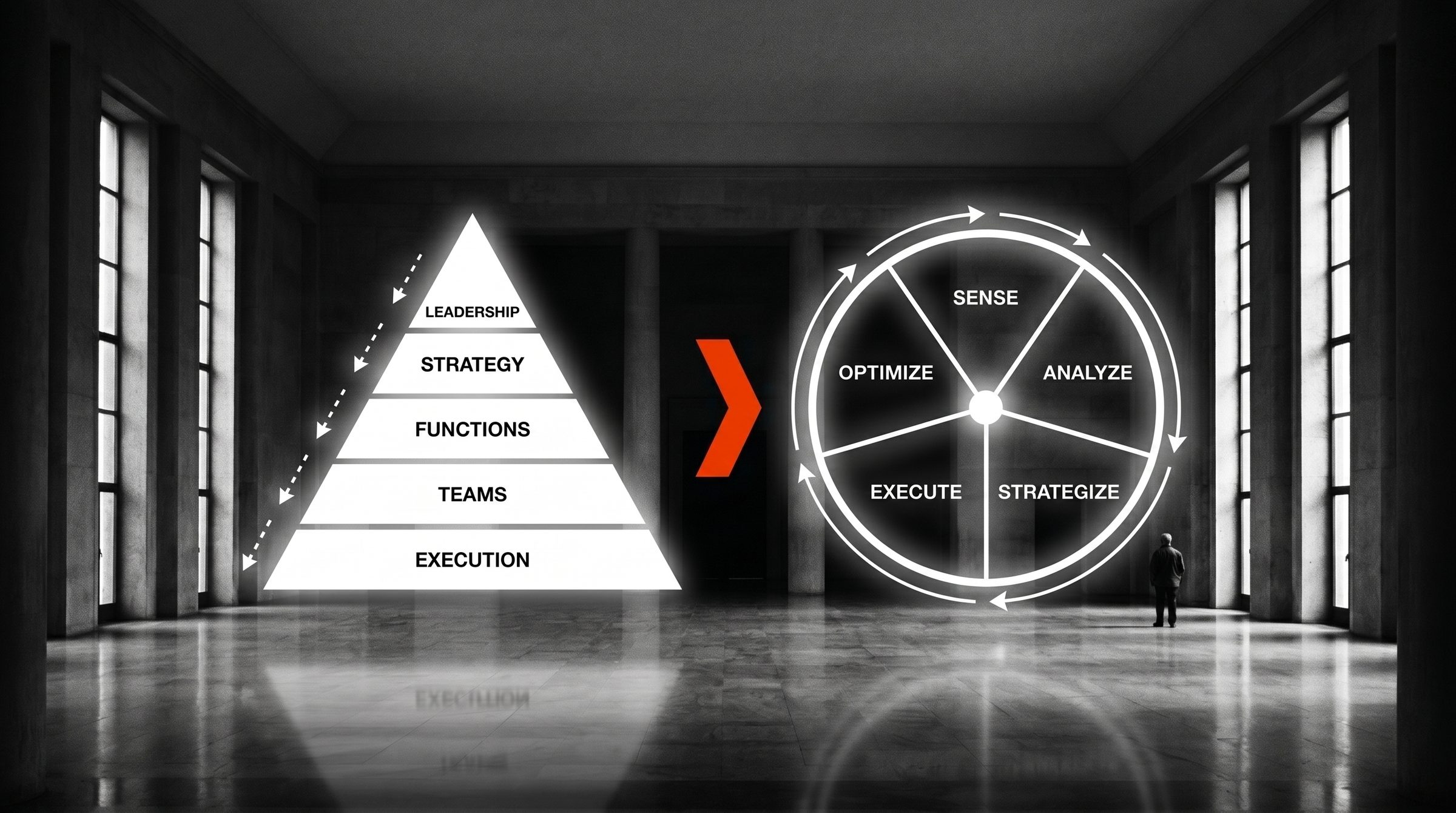
From pyramids to pizzas. The shape of the organisation: industrial-age pyramid to a flat, circular, always-running operating model. An organisational metaphor; the Brand OS loop itself runs the cycle shown above.
So where do the people go? They move to the edge. In the old organisation a person stood inside the workflow, doing the steps. Now the agents do the steps, and the person stands at the boundary and enters at the moments that decide it. Some human work remains inside, but the default has inverted: the agent-run workflow is the body of the work, and people are the judgement and the humanity that enter where it matters. The loop moves. The edge holds.
Govern, curate, architect
Three kinds of work happen at that edge. Two keep the brand right; the third keeps right the system that renders it. And none of it belongs to the brand department alone: the edge holds decision rights from brand, product, legal, data, service, and engineering, because the system it governs touches all of them. Brand becomes a governance layer the enterprise shares.
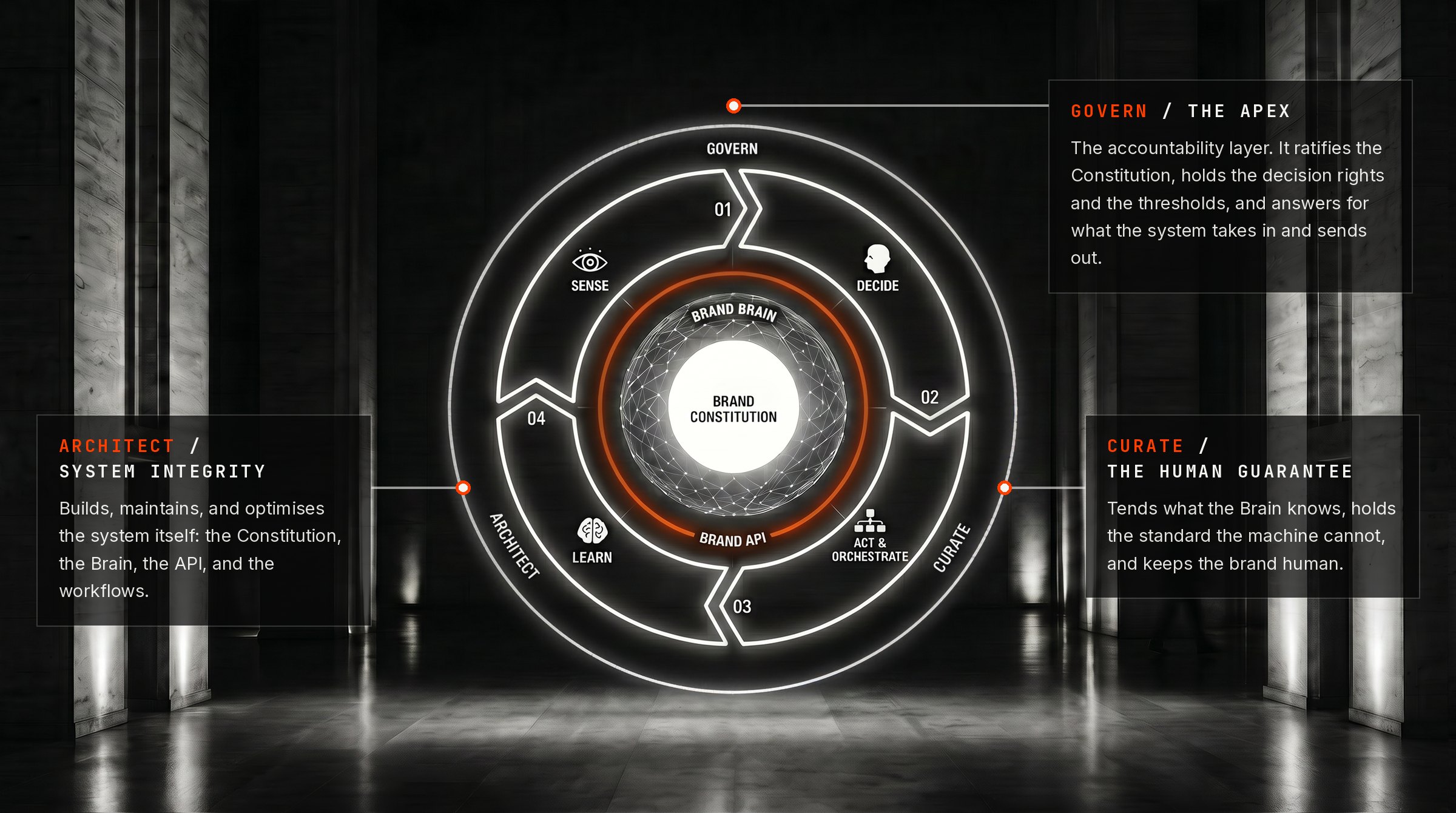
The human edge: govern, curate, architect. The agents run the loop; the people hold the ring. Govern at the apex answers for the constitution, curate ratifies what is new, architect keeps the machinery true.
The first is governance, the accountability layer. Someone decides the brand's ontology and sets the thresholds an agent acts within: what it may promise, what it must never say, what it may offer before a person is asked. Someone holds the decision rights and the exceptions, and is accountable for what the system takes in and sends out. These are not technical decisions in costume; they are the most consequential brand decisions there are, in a form a system can run.
The second is curation, the word our industry will undervalue, because it has gone soft. I do not mean arranging, the museum-wall sense. I mean the harder thing: maintaining what the brand knows and keeping it human. Curators tend the Brain, the knowledge the system renders from, and hold the standard the machine cannot. An agent can render the brand; it cannot tell a reply that is technically correct from one that sounds like you, or feel the difference between meeting a customer as a person and meeting them as a data point. That judgement lives in people. And it is the curators the system escalates to when it meets what the Constitution and the case law do not cover; their rulings are how the brand's case law grows.
The third is architecture, the work of building, maintaining, and optimising the system itself: the Constitution, the Brain, the API, the workflows. Call them system architects, or agentic-workflow engineers; they design and keep improving the machine that renders everything else, and they are the role our org charts have not yet learned to name.
This is the answer to the fear underneath all of it: that a brand run by AI becomes a hollow one. The defence is structural, not sentimental. The people who govern and curate are the guarantee that the brand stays human, because they hold a standard the machine cannot hold alone. An agent does not create humanity. It infers it, and it can only infer what someone had the discipline to encode. I wrote a line in the manifesto I keep returning to: human experience needs to go in for human experience to come out. The operating system is how that becomes true at scale.
The system renders the brand. The people at its edge are what keep it authored.
That word — authored — is the point. The test I have always used on brand work is whether it feels authored rather than generated. It is now the test for the brand itself. Whether it stays authored, whether a person stands behind what the machine produces and holds it to something, is decided entirely by who is at the edge and what they are allowed to govern.
The filter, and the forge
Two honest notes. Moving to the edge is not a promotion for everyone: when the system carries the coordination, the people whose value was the coordination are exposed, and much of what passed for judgement turns out to have been context-carrying the machine can now do itself.
And the edge runs on judgement that was always forged in execution: you earned an eye by making a thousand wrong calls at the base of the pyramid. If the agents now do the execution, we have automated the forge, and an organisation that automates execution faster than it grows judgement is eating its own future. The repair, apprenticeship built deliberately back into the system, is the next piece. I will not pretend to settle it here.
Here is where it lands. The brand is being rendered, in real time, by systems no one fully controls. The defence is not a better document; it is an operating system: a heart of Constitution, Brain, and API, a governed loop running on it, and people at the edge who keep it human. And the agent between you and your customer will not only ask what your brand says. It will ask whether the world confirms it. So the work is to build the operating system, govern the whole brand rather than the costume, and keep the people who keep it authored.
Notes
- Google, "The next evolution of the Gemini app," The Keyword, May 2026. blog.google
- Apple, "Apple Intelligence — WWDC26 guide," Apple Developer, June 2026. developer.apple.com
- Microsoft, "Project Solara," Microsoft Build 2026, June 2026. commandline.microsoft.com
- Thomas Marzano, "Brand Constitutions — The Manifesto," Brandingmag, November 2025. brandingmag.com
- Salim Ismail, Michael S. Malone and Yuri van Geest, Exponential Organizations, Diversion Books, 2014. Updated living edition: The Organizational Singularity: How AI Breaks the Firm and Rewrites It, OpenExO, 2026.
- Jack Dorsey and Roelof Botha, "From Hierarchy to Intelligence," Block, 2026. block.xyz. Discussed in Thomas Marzano, "Who Sets the Defaults," April 2026.

Because authored, in the end, is just the exact and demanding word for human.