The Lovable Becomes the Provable
The agents are here. They read what a brand makes legible and render it before the customer ever reaches a surface the brand controls. What they cannot manufacture is the thing that makes a brand loved: the lived proof that what a brand says and what it does are the same. That is where brand now lives.
The Lovable Becomes the Provable, the screen edition · 25 pages, PDF, 4.8 MB. Free download.
We became operators of the machine
For decades, digital technology did not simply serve us. It trained us.
It trained us to search, scroll, click, compare, upload, configure, filter, navigate, subscribe, unsubscribe, manage and troubleshoot. The more capable the machine became, the more fluent we had to become in its operating grammar.
We called it empowerment, and in many ways it was. But it carried a hidden cost. Human beings became the operating layer of the digital world.
Brands followed us there. They learned to compete inside the surfaces where our attention was trapped: search engines, social feeds, ecommerce flows, landing pages, retargeting loops, app notifications, content calendars, conversion funnels. They optimised for what they could measure. Clicks, time on page, scroll depth, return rates, conversion paths.
Much of modern brand building became the art of being noticed while people were busy operating the machine.
This is not a moralistic point. It is a strategic diagnosis. Brands went where attention was, and attention was trapped inside the operational friction that everyday digital life had become. The attention economy was not only built on desire. It was built on dependency. People had to be inside the surfaces, so brands learned to compete there.
The attention economy taught brands to mistake interruption for presence.
We have spent twenty years building brand systems that assume the surface is the relationship. Engagement metrics. Content velocity. Funnel design. Persona-targeted creative. Each is a sophisticated answer to the same question: how do we matter inside the friction?
It was the right question for the time. It is now the wrong one.
The interface is receding, and now it has a ship date
For most of the last year, the shift I am describing was a trajectory. A reading of where the structure had to lead. As of 2026 it is no longer a reading. It is a published product roadmap.
At Google I/O 2026, the company with the most consumer distribution on earth stopped announcing features and announced an architecture: a model, an agent, a search box that builds its own interface, a cross-merchant cart, payment rails, a personal assistant that runs in the background. AI Mode has now surpassed a billion monthly users, with Gemini 3.5 Flash as its default model. The direction is unambiguous: Search is moving from ranked retrieval toward generated, agentic response. It no longer only returns a list of links for you to operate, it can also compose the answer. In Google's own words, it can "build you the ideal format exactly for your question, completely custom, on the fly."
This is the moment the interface began to recede in public, at scale, with a date on it.
It does not disappear overnight. Launch is not adoption, and the dissemination into everyday consumer behaviour will run over the next year. But the direction is no longer arguable. The website, the app, the owned journey do not vanish. They stop being the primary destination and become substrate: the structured source the agents read from.
This is technology coming of age. The digital revolution gave us extraordinary capability and asked us to operate increasingly complex machinery to extract it. AI begins to absorb that operational burden. What changes is the human's role. From operator to director. From navigator to judge. From searcher to evaluator. The human moves up the stack, out of the work of operating the systems and into the work of directing them.
Most marketing budgets, most content systems, most measurement frameworks were built to compete for attention inside the operational layer. When that layer recedes, the architecture of the attention game changes with it.
The decisive agent is not yours
The new actor in this picture is not the brand's chatbot. It is the customer's agent.
A user-side agent, the personal AI working on behalf of the customer, knows the customer in a way no individual brand can match. Their preferences and history, their routines and standards, their budget and calendar, their values and constraints, the purchases they made and the ones they regretted, their context in real time. At I/O, Google gave this agent a name and a release date: Gemini Spark, a background assistant meant to work for you around the clock.
That agent does the operational work that used to occupy the customer's attention. It searches and compares. It summarises and recommends. It negotiates and transacts. Google's Universal Cart, rolling out across Search and Gemini, points the same way: a shopping layer that works across merchants and services, monitors price, stock, compatibility and payment perks, and begins to shift the comparison work away from the customer. The shortlist is increasingly built somewhere brand managers cannot see.
Which means brands are now interpreted by intelligence they do not control. Not will be. Are.
The comparison criteria are set by the customer's standards, not the brand's positioning. The brand's owned messaging is one input among many, and rarely the most weighted one.
This is the strategic tension behind the Legible-Lovable Law. To reach a customer through their agent, a brand must be legible enough for the machine to read it accurately, and lovable enough for the human to want it once read. Legible without lovable produces a brand that gets parsed but never chosen. Lovable without legible produces a brand the agent cannot confidently surface, so it never reaches the human at all.
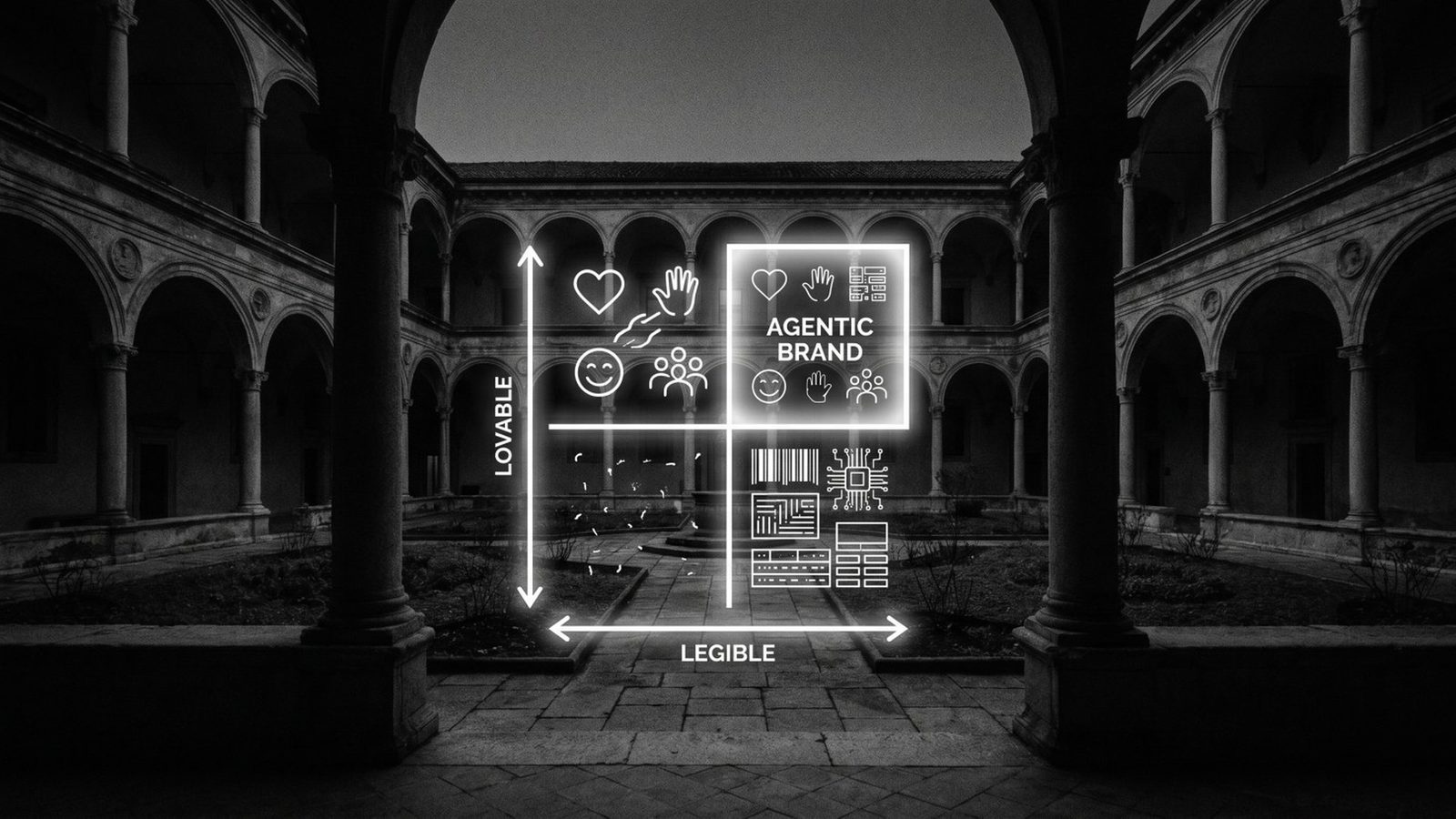
Both halves are required. Neither substitutes for the other.
Most of what we called engagement was friction
Once the operational layer recedes, something becomes visible: a great deal of what we called brand engagement was operational residue.
Time spent comparing specs because comparison was hard. Hours inside service portals because the portal was the only path to a human. Endless product-grid browsing because nothing had filtered for relevance. Repeated form-filling because no system remembered. Retargeting that landed after the customer had already decided. Time spent on a surface is not the same as relationship. Engagement is not meaning. The dashboards were measuring the friction, not the brand.
This does not make those metrics useless. It makes them incomplete. They told marketers how people moved through the machine, not what people valued, trusted, remembered or loved. In an interface-heavy world that distinction was easy to ignore. In an agentic world it becomes impossible to avoid.
The lovability gap
Here is the question the entire industry is leaving unanswered.
When the agent reads your product data and renders the comparison, when the cart assembles itself across merchants, when the answer arrives composed and custom before the customer has typed a second query, the customer may never reach a surface you control. No homepage. No campaign. No store you designed. The agent reads what is legible. It renders what it reads.
So where does the lovable half live?
For twenty years in digital marketing the answer was obvious. Lovable lived on the surface: in the film, the landing page, the art direction, the copy, the campaign that made someone feel something. The surface was where a brand earned desire. That surface is now, increasingly, rendered by someone else's intelligence, in a format the brand did not design, at a moment the brand cannot see.
The dominant platform architectures are overwhelmingly built for legibility: structured data, commerce protocols, provenance, identity, retrieval and rendering. Lovability remains the unresolved layer. The industry has solved how a brand is read and left wide open how a brand is loved.

The answer is not to fight for the surface, which is no longer guaranteed to be the primary stage. Lovability relocates instead to the one thing the agent reads that a brand cannot fake: the lived evidence of how the brand actually behaves. A brand cannot render warmth into an agent's summary. But it can be the brand whose product the world says is better, whose service the reviews say is kinder, whose promises the data confirms were kept. The agent reads that. It renders that.
The lovable becomes the provable.
Brand experience as the proof layer
This is the move. Brand experience, what the brand actually does in the world across every touchpoint where it meets a customer or an employee or a partner, becomes the proof layer of the brand. Not a downstream design treatment. Not experiential marketing. Not retail theatre. The lived evidence from which both humans and agents infer trust.
Years ago, in my work on brand experience design at Philips, the discipline was already clear in outline. The brand experience playbooks we developed translated the master brand into category relevance and orchestrated principles across physical, digital, service and communication touchpoints. The aim was coherence beyond a single product or a single campaign: coherence across a whole business domain, sustained over time. I returned to the same question in a chapter I contributed to Brian Solis's X: The Experience When Business Meets Design, the recognition that a brand becomes meaningful only when it is rendered coherently across the moments where it touches people's lives. I learned this before agents made the problem obvious. Coherence across a business domain has always been the harder discipline.
The agentic shift makes that logic central in a way it was not before. When a user-side agent forms a recommendation, it does not assemble the brand from campaign assets. It assembles the brand from everything the world says about it: reviews, communities, product data, third-party commentary, service patterns, employee signals, return-policy reality, public behaviour. The brand the agent sees is the brand that has actually been lived.
Google's own Search now demonstrates the phrase the doctrine has used for a year: the brand is rendered, not retrieved. The agent does not fetch your brand from a page you wrote. It renders your brand, in the moment, from whatever evidence it can read.
The chain runs in one direction. Lived experience generates human memory. Human memory becomes social proof. Social proof becomes digital footprint. Digital footprint becomes machine-readable evidence. And machine-readable evidence becomes the material the agent uses when it renders your brand to its human.
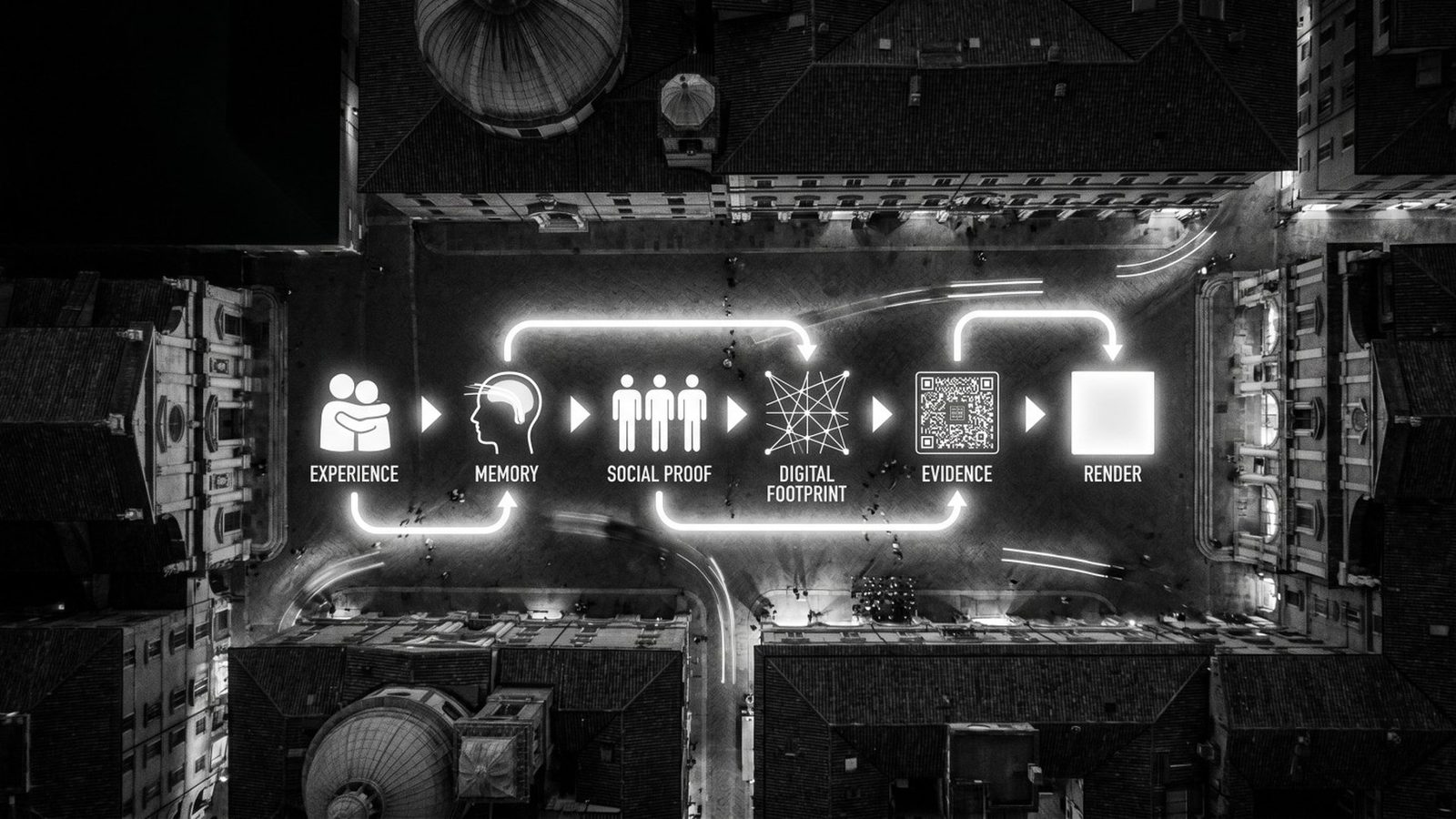
The Brand Constitution is what holds that chain together: the governed source of truth that lets the lived brand be machine-readable without being hollowed out.
If lived experience is weak, the chain breaks at the first link. No campaign downstream can repair what was not generated upstream.
Costume brands will crack

The agentic economy is hostile to costume brands.
A costume brand performs identity on the surface while the business underneath behaves differently. It can have a polished visual system, a strong campaign platform, a confident editorial voice, a productive content machine, high production values everywhere the brand speaks. But underneath the costume the product disappoints. The service contradicts the promise. The claims lack evidence. Pricing behaviour erodes the trust the campaign tried to earn. Retail and digital do not feel like the same brand, the employee experience contradicts the stated purpose, and the loyalty programme extracts where it claimed to reward.
Today costume brands can survive, even thrive, because the attention economy rewards surface performance. The campaign moves the metrics, the metrics fund the campaign, and the customer's lived disappointment is absorbed into churn or buried in the long tail of reviews no one consolidates.
In the agentic economy that protection collapses.

Agents do not summarise only what the brand says about itself. They compare it with what the world confirms. The comparison logic now being built to weigh price, stock and compatibility extends naturally to weighing claim against evidence: reviews and complaints, third-party commentary, return-policy data, service-time patterns, sustainability claims against actual sourcing, the difference between what the customer was promised and what the customer received.
The integrity gap becomes visible, computable, and commercially dangerous.
A brand that performs better than it behaves used to be a sustainable business model. It is becoming a liability.
The CMO after the interface
For the CMO, the shift relocates the work itself.
The CMO of the interface era was responsible primarily for visibility, campaigns and communication. The CMO of the agentic era is responsible for governing meaning across experience.
That work continues. Campaigns and communication do not become irrelevant. But they stop being the primary task. The deeper task is to shape, with real authority, how the brand actually behaves wherever it meets people: in the product, in the service, in the pricing, in the way the company answers a complaint, in the data exposed to the agent layer, in the partnerships that carry the brand into territory the brand does not control.
This does not require the CMO to own every touchpoint operationally. It requires governance over the brand logic that shapes them. Without it, the CMO manages the campaign layer of a business whose brand is being formed elsewhere.
If customers no longer had to search, scroll, compare, browse or navigate your digital surfaces, what would remain of your brand? Where does your brand create real human proof beyond campaigns, content and identity? Where is the gap between what your brand claims and how your business behaves? Can a user-side agent understand why your brand should be trusted without relying on your own messaging? And, the question that decides the others: do you govern how the brand behaves across the organisation, or only the costume it wears in communication?
The answers may not be flattering. They are not meant to be comfortable.
A CMO who governs only the costume will increasingly govern only the weakest part of the brand.
The CMOs who matter in the next decade will not be the ones who optimise the campaign layer most aggressively. They will be the ones who win and exercise the mandate to govern brand behaviour across the organisation. Product, service, sales, support, community, partnerships, employee experience, claims and proof, agent-facing brand logic: all of it becomes brand work. Not because the CMO must do all of it, but because when the costume can no longer carry the brand, someone has to govern what is actually being built underneath it.
What to start
The work is not to add an agentic layer on top of the old model. The work is to change what the brand system is built to govern.
- Start treating brand experience as strategic infrastructure. Not a downstream design layer or an activation tactic. The lived evidence of the brand.
- Start mapping the integrity gap. Compare what the brand claims with how the business actually behaves, across product, service, pricing, onboarding, support, partnerships, sustainability, aftercare and public behaviour. Find where the surface and the substance diverge.
- Start codifying the brand as governed meaning. Not a tone-of-voice document or a campaign platform. Structured logic that can guide behaviour, content, claims, partner action, and the systems that will represent the brand through agents. This is the work the Brand Constitution names.
- Start owning the substrate, not renting it. The brand's knowledge and the rules that govern it are now strategic assets. Decide deliberately what you expose through a platform and what you keep sovereign.
- Start designing explicitly for the user-side agent. Assume the customer's intelligence will filter, compare, summarise and decide on the customer's behalf. Make the brand legible outside its owned surfaces.
- Start giving the CMO real governance authority. Not only communication ownership. Actual mandate over how the brand behaves across the organisation.
What to stop
- Stop confusing digital attention with brand strength. Attention is not trust. Engagement is not meaning. A click is not a relationship. A conversion is not a brand.
- Stop producing content that creates no proof, no memory, no trust and no meaning. Content that does not help a person or an agent understand why the brand matters will be compressed away.
- Stop treating brand as a costume. Brand is not the campaign layer placed over the business. It is the meaning the business earns through behaviour.
- Stop assuming owned surfaces are the primary place where the brand is judged. Increasingly, the brand will be judged through distributed evidence the brand does not own: reviews, communities, product data, service patterns, public behaviour.
- Stop building brand systems only for marketers and designers. The brand system has to be usable by every function whose behaviour the customer will eventually meet.
What to scale
- Investing in distinctive identity. Visual and verbal distinctiveness remain essential, but they have to be connected to evidence. Distinctiveness without behavioural truth is the costume.
- Building digital excellence. Digital recedes from destination but advances as orchestration, intelligence, transaction and structured knowledge.
- Building community. What people say, share, defend and recommend becomes part of the brand's machine-readable footprint. Community matters more, not less.
- Creating consequential content. Only the content that creates proof, memory, trust and clarity. The rest becomes noise.
- Aligning brand and business strategy. The alignment of brand strategy with product, service, operations, culture and commercial strategy is no longer optional. It becomes the operating mandate.
The irony of the agentic age is that the most machine-ready brands will need to become the most human.
Not human as a tone of voice. Not human as synthetic empathy. Not human as a chatbot with warmer language.
Human through evidence. Human through experience. Human through trust. Human through coherence between what a brand promises and how it behaves.
The agents are already here. They read what a brand makes legible, and they render it before the customer ever reaches a surface the brand controls. What they cannot manufacture is the proof that a brand is what it claims to be.
So they will look for it. They will not only ask what a brand says. They will ask whether the world confirms it.
That is why costume brands will crack.
And it is why agentic brands will need to be more human than the brands of today.
The Lovable Becomes the Provable, the screen edition · 25 pages, PDF, 4.8 MB. Free download.
Questions this essay raises
What is the proof layer of a brand?
The proof layer is brand experience: everything the brand actually delivers, across the digital surfaces an agent renders and the real-world surfaces the brand manifests. It is the material from which both people and agents infer what the brand is. Lived experience becomes memory, memory becomes social proof, social proof becomes a digital footprint, and the footprint becomes the evidence an agent reads when it represents the brand. A campaign cannot rewrite that chain after the fact. That is why, under the Legible-Lovable Law, the lovable becomes the provable.
What is the integrity gap, and why can agents see it?
The integrity gap is the distance between what a brand says and what it does. In the attention economy it was hard to see at scale: customers felt it, but rarely added it up. Agents read both, compare them, and surface the difference when it matters. In the agentic economy the integrity gap becomes computable. It cannot be messaged shut.
Where should a CMO start?
With the integrity gap: map where what the brand claims and how the business behaves come apart, across product, service, pricing, support and partnerships. Then codify the brand as governed meaning. A Brand Constitution is the governing logic of the agentic brand: the codified rules, principles, and decision boundaries that determine how the brand should act. It is ratified by whoever is accountable for the brand, which is why the CMO's mandate has to reach how the brand behaves across the organisation, beyond what it says.
Where this sits
Agentic Branding is the discipline of making brands intelligible, governable, and desirable in an AI-mediated world.